






Embroidery or print? Neither one is better.
Most people arrive expecting a winner. It's the wrong question — and answering it the wrong way is how businesses end up with kit that looks tired after a dozen washes. The right choice depends on three things working together: the garment, the logo, and the job it has to do.
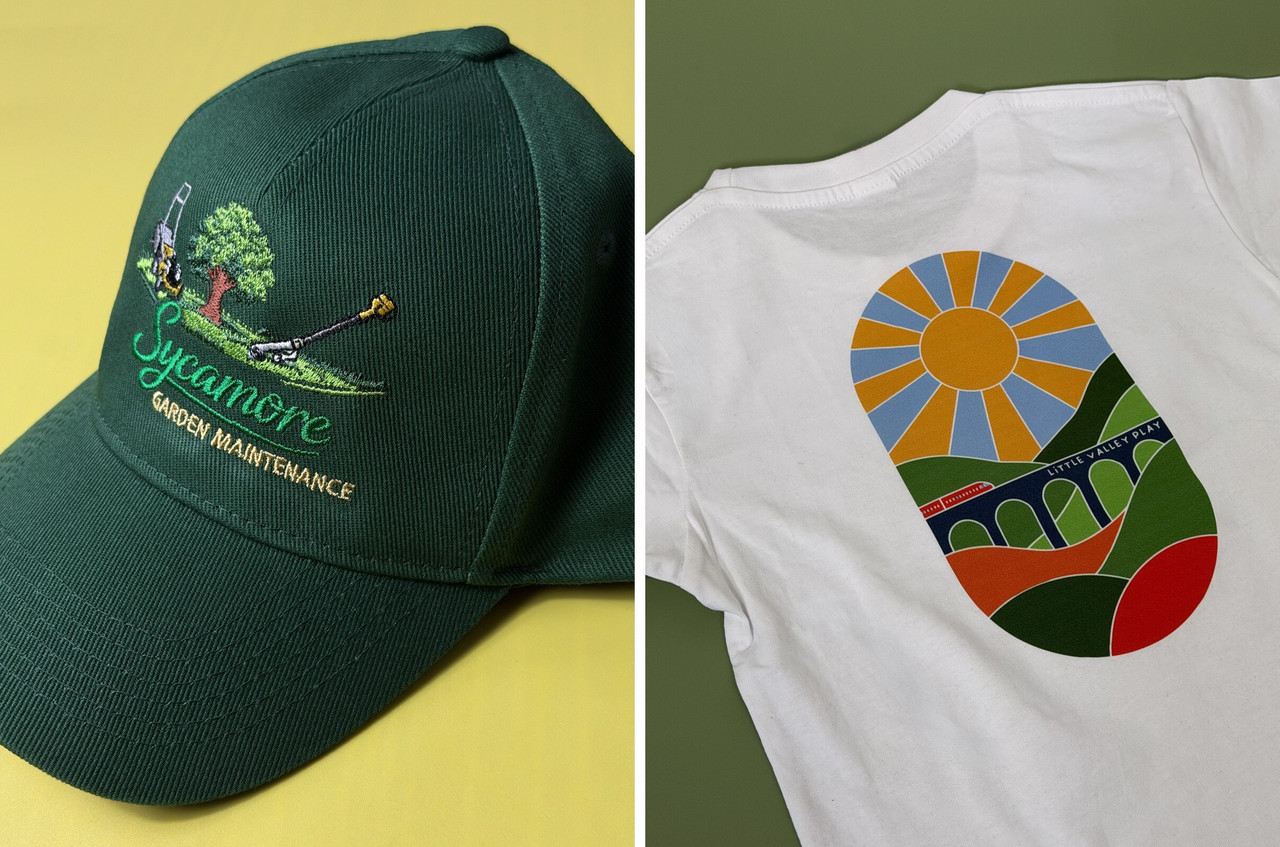
Thread versus ink
That one difference is the root of everything below. Get the three things right — garment, logo, job — and both methods produce work you'll be proud to hand out. Get them wrong and even the best machine in the country can't save it.
Your logo, stitched into the fabric
The needle runs at around 850 stitches a minute, punching thread through the fabric into a backing that holds everything stable. It's hard-wearing, has real depth and texture, and looks the part on heavier garments.
Your design, bonded on as ink
DTF stands for direct-to-film: the design is laid onto the garment as ink, held on by an adhesive bonded under heat at roughly 130–150°C. It reproduces full colour in one pass, including detail and shading thread simply can't hold.
The garment has to last
Embroidery earns its place on garments that need to survive and logos that are clean and bold — polos, softshells, jackets, gilets. Anything mid-weight or heavier, and anything a wearer keeps for years rather than a season.
The headline reason: embroidery outlasts the garment. In practice you'll usually see holes wearing through the fabric long before the stitching gives up. On a jacket someone wears for three or four years, that matters.
- the garment is substantial — outerwear, softshells, heavier polos and tees;
- the logo is clean and bold — clear shapes, solid colour, readable text;
- it needs to look premium and hold up to daily wear.
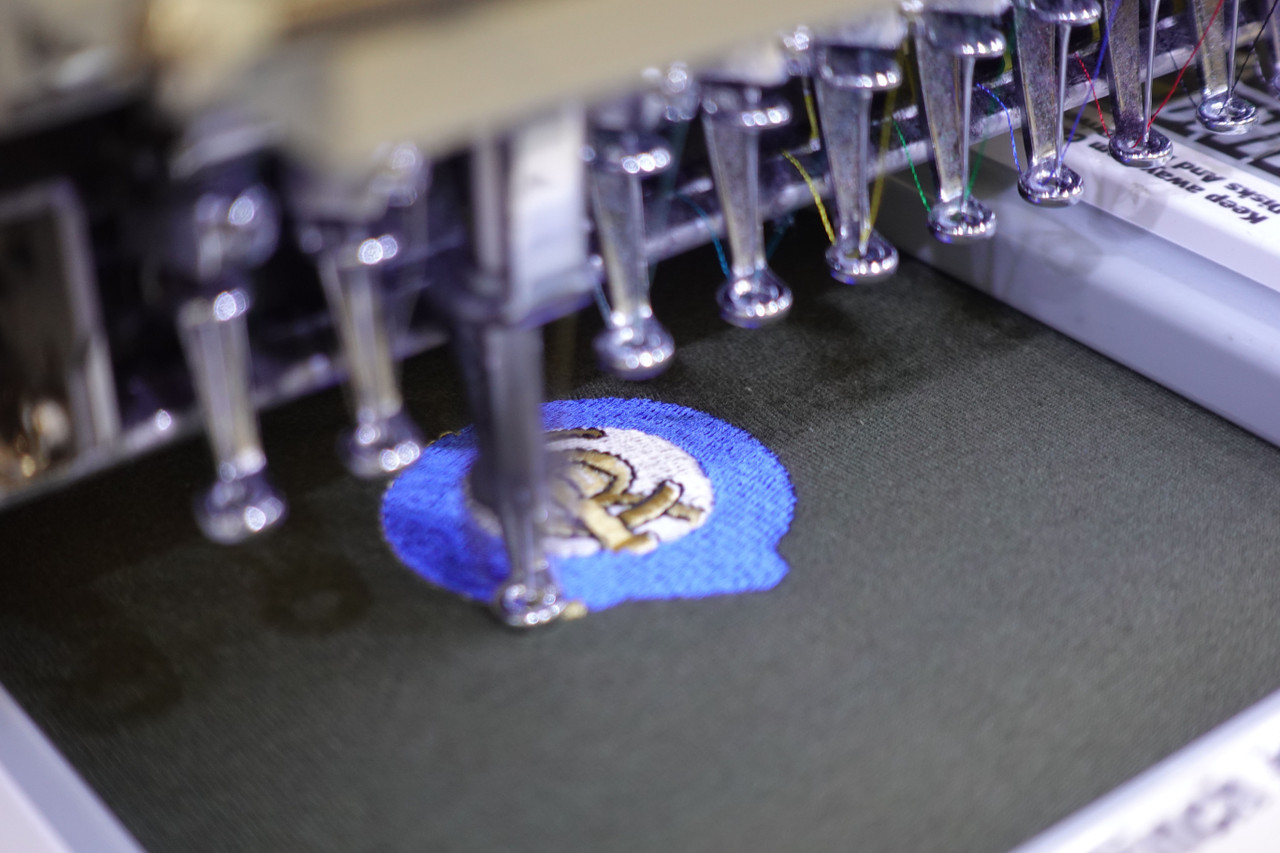
Where embroidery struggles: fine detail. Very small text, delicate lines, gradients and photographic detail don't survive being rendered in thread — they blur or get lost. Two specific traps worth knowing:
- Big colour fills on thin garments. Laying down a large block of stitches tugs the fabric — we call it pull compensation. On light, thin material that pull can be severe enough to leave a small gap around the edge of a fill, no matter how well the design is prepared. It's a known limitation, so we steer away from it.
- Caps. A flat garment holds a logo through tension and backing; a cap holds it through structure. Six-panel caps in particular can have a seam running up the middle that swallows stitching. The right cap and a well-framed machine make the difference.
And a note on weight: heavy, dense embroidery on a light garment adds bulk and will pucker sooner. Bigger isn't better with stitching.
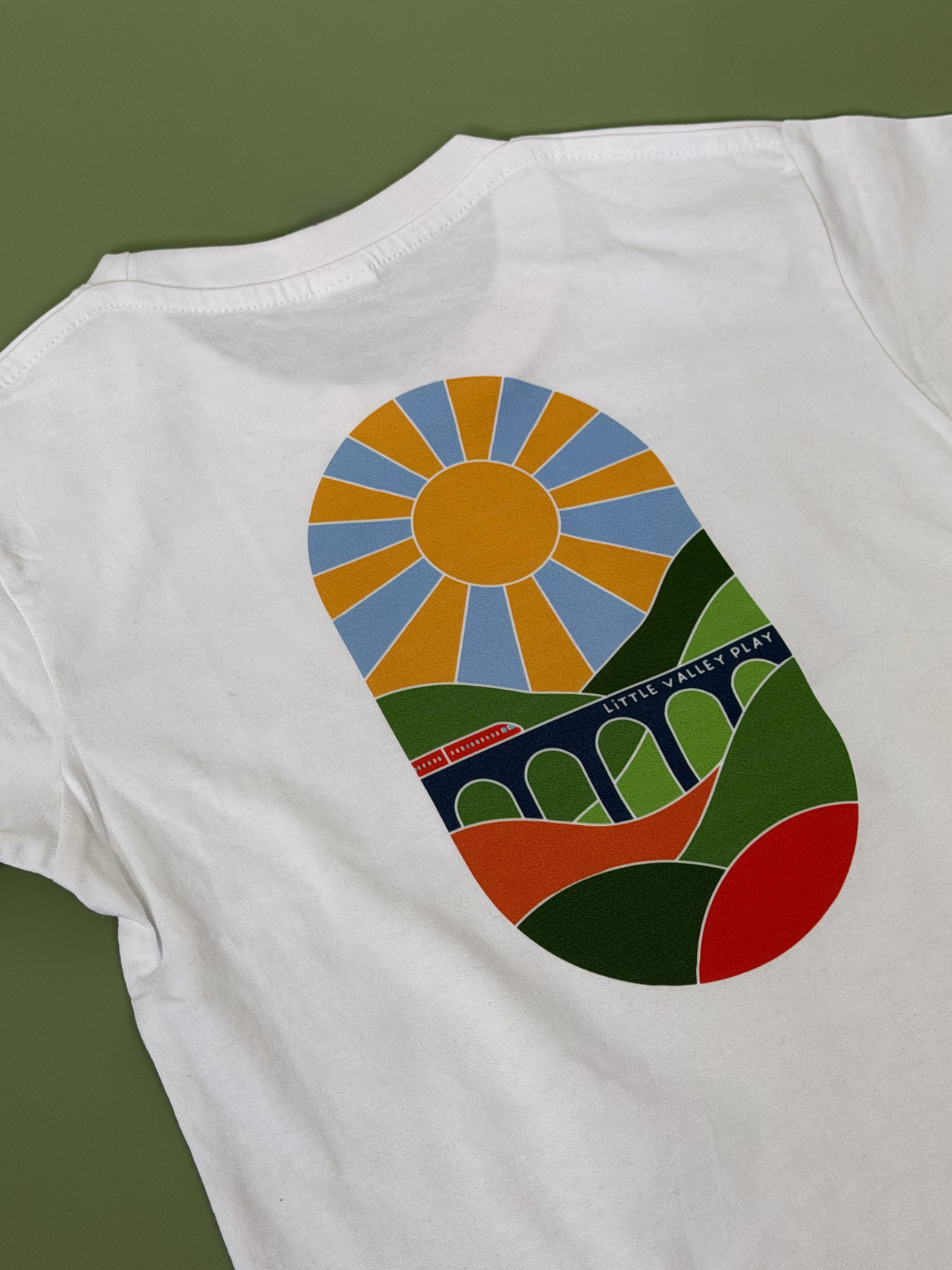
Colour and detail matter most
Print comes into its own exactly where embroidery runs out of road.
- the garment is lightweight — tees, performance tops, thinner fabrics where stitching would add unwanted weight;
- the logo has gradients, blended colours, photographic elements or lots of fine detail;
- it's a giveaway, event or shorter-life item where you want the cost to match the garment's life;
- you need full colour reproduced faithfully in one hit.
Print is also remarkably versatile — it goes onto fabrics, and even some non-garment items, that embroidery can't touch.
Its limits are the mirror image. Print struggles with fine photographic detail, heavily blended backgrounds, watermarks and very thin artwork. It can't be shrunk indefinitely either — because the ink is held by adhesive, going too small leaves too little to grip the finest detail. And it won't survive certain heat-treated fabrics, where the finish reacts with the process.
Your logo decides more than the method does
This is where jobs are quietly won or lost — long before anything reaches a machine.
Bring the cleanest version of your logo you can. A tiny file just a few kilobytes in size carries no real detail; a flat image (a PNG or JPEG) often has to be redrawn into a clean, scalable version before it can be used well. That's fixable, but it's worth knowing up front.
A word on AI-generated logos. They look fantastic on screen — and they're often fine for print, an email footer or the side of a van. But if you've had one made with heavy detail — a cartoon character, a scene, a building in the background — that detail will not translate into embroidery. It has to be simplified first. If you're creating a logo with an AI tool and you know it's going on clothing, the single most useful thing you can do is ask it to make the logo embroidery-friendly and simplify it.
Expect colours to differ slightly between methods. Print colour and embroidery colour will never match each other exactly — they're different materials doing different things. If an exact colour matters to you, tell us, and we'll work to a reference rather than guess.
Small text and straplines are the other common snag. A logo that reads perfectly across the back may need its strapline widened or split over two lines to stay legible on a left chest. That's the kind of thing our proof stage is designed to catch.
The logo is there to catch the eye, not do a presentation.— Penguin Uniform production team
It's the fabric, not the price tag
Spending more on a garment does not automatically give you a better-looking finish. What actually decides how well decoration performs is the fabric.
Polyester tends to take print beautifully. A cotton-knit polo tends to take embroidery better — though print can work into the knit and will wear over many washes. A tightly knitted fabric behaves differently from a relaxed one. So the question isn't "how much did it cost?" — it's "what is this garment made of, and what's it for?"
Choosing the right garment for the job goes into that properly.
Making it last
Whichever finish you choose, a little care goes a long way.
- Wash printed or embroidered garments inside-out at 30°C. Hard-wearing garments can take up to 60°C, but never wash print above 40°C — hot washes break down the adhesive holding the ink.
- Skip the tumble dryer for prints (it causes cracking and peeling), and go easy on strong fabric softeners, which attack the inks.
- As a rule of thumb, a good DTF print lasts comfortably through 30–40 washes, often more. Embroidery, as noted, tends to outlast the garment itself.
One technical note if you're branding waterproof jackets: stitching a logo means the needle passes through the waterproof membrane, which affects the waterproofing at that spot. It's a solved problem — we reseal it from the inside so water can't get through — but it's worth knowing why a waterproof garment is handled with extra care.
You don't need to memorise any of this
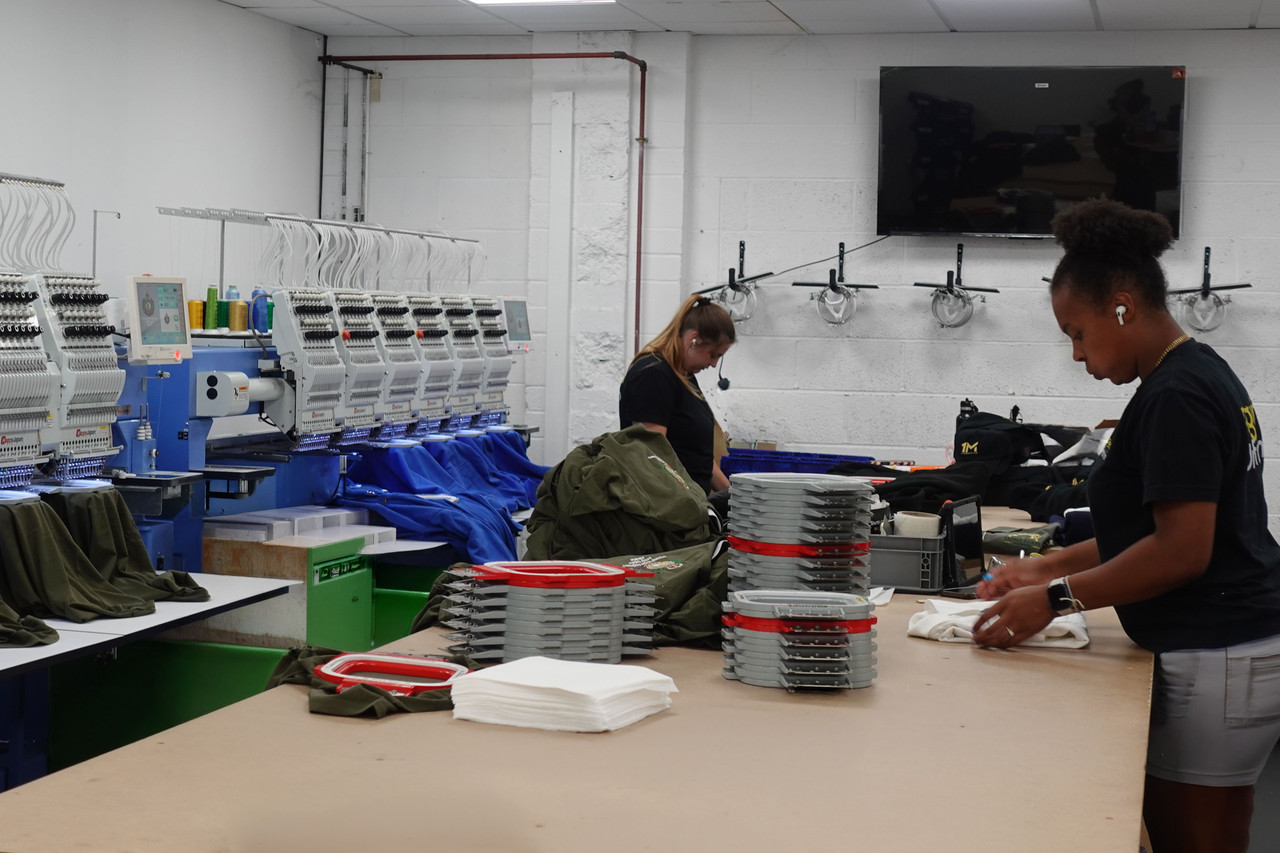
Our job is to take your logo, your garment and the way it'll be used, and tell you honestly what will and won't work — before anything is made, not after.
That sometimes means recommending the cheaper option, or moving you to a different garment, or telling you a logo needs simplifying. We'd rather do that than produce something we know won't perform. Every job goes through a proof and sign-off stage for exactly this reason — your chance to check colours, spelling, size and placement, treated as a proper approval, not a formality.
Weighing it up for a specific job?
Tell us what the garment is, what the logo looks like, and who's going to wear it. From there we can point you to the right finish — and if the honest answer is "it depends," we'll explain exactly what it depends on.
Keep deciding with confidence
Getting Your Logo Ready
What makes a logo decoration-ready — and what doesn't.
Choosing the Right Garment
Pick by the job, not the price tag.
Will Your AI Logo Work?
The one-minute fix for an AI-generated logo.
Branding Waterproof Jackets
Why the membrane changes how it's handled.
Making Your Workwear Last
Wash care that protects the finish.
The Penguin Academy
Advice-first guides to help you decide before you order.